I Want to Upload All My Cds to My Phone How Do I Do That
Eugene writes a variety of articles on the Maven coalition network of sites, covering topics such every bit gardening, DIY, photography, and STEM.

How many audio CDs have you got? ten, 100? one thousand? Wouldn't information technology be nice to have your unabridged music collection at your fingertips on your phone, tablet or notebook computer? YouTube Music allows you to do this and the steps to uploading music from your CDs to the cloud are reasonably straightforward and something you lot could do on one of those rainy days!
What Are the Steps to Getting Your Music Drove Online?
- Rip the CDs using iTunes, Audio Grabber, Microsoft Media Player or similar software.
- Upload the tracks from hard bulldoze or flash memory to the YouTube Music website
- Once the tracks are online, they can be accessed from a desktop computer or mobile device
What Does "Ripping" a CD Hateful?
Ripping music from a CD refers to extracting the digital sound sound tracks from the disk and saving this music data (e.g. in the form of an MP3 file) on another CD, PC, mobile device or mobile music player.
Is Ripping Tracks from a CD Legal?
It depends on the land. Copying CDs and giving the copy to a friend or giving them the copy and then they can make their own is a definite copyright violation and illegal. Putting music tracks on a website and sharing your collection is likewise illegal. Making backups for your own personal use is a more fuzzy area. In many countries a levy is paid to content producers to compensate them for any loss due to copying. The state of affairs is different in the UK however. Legislation in October 2022 made it legal to rip CDs for backup purposes or "format shift" so you could play the MP3s on your telephone or PC. At present that legislation has been overturned and information technology'due south illegal to do so. In the US, according to the RIAA, it's ok to copy content onto an Audio CD for personal use and:
"...transferring a re-create onto your figurer hard drive or your portable music player, won't unremarkably raise concerns so long as....The copy is fabricated from an authorized original CD that you legitimately own...."
How to Rip CDs
Stride 1. Install iTunes or Other Ripping Software
There are several well known media player applications that can be used for listening to CDs, MP3 or other format audio files, podcasts, Internet radio stations, watching videos or movies and management of a music collection. ITunes is but ane of these and information technology's very easy to use. ITunes can too rip CDs or extract the tracks off them and store those tracks equally files on your computer. You can download iTunes from the Apple website here:
Apple iTunes download
One time tracks are imported, they terminate up in your iTunes library.
The iTunes Music Library Screen
This differs somewhat between versions. The first screen capture shows an older version I used to rip a CD. The reason information technology'southward older is because the laptop I used runs Windows Vista and has a CD drive. It's the last version of iTunes for that operating system. Newer desktops and laptop computers don't normally take integrated CD/DVD drives, but you can buy an external 1 that plugs into a USB port. The second screen capture shows what the latest version of iTunes now looks like on Windows x.
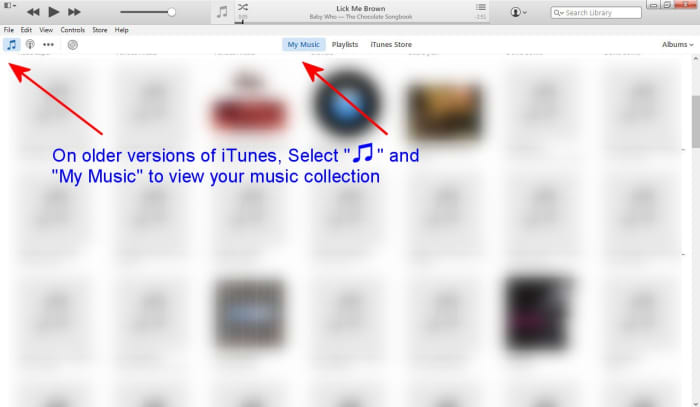
Viewing albums in iTunes on Windows Vista.
© Eugene Brennan
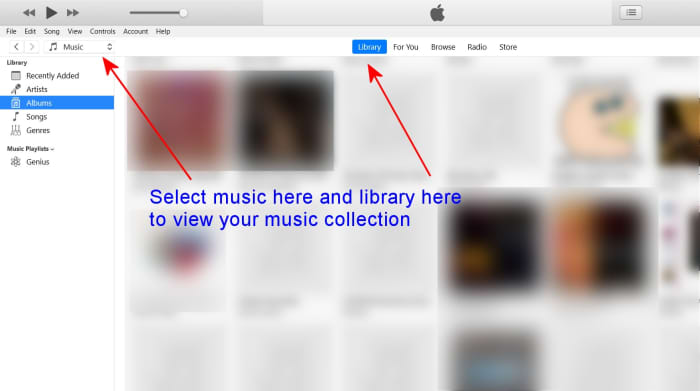
Viewing albums in iTunes on Windows 10. Choose "Music" from the popup carte on the acme left of the screen then click "Library".
© Eugene Brennan
Stride two. Insert a CD
When you insert a CD which iTunes hasn't seen earlier earlier, it starts retrieving information near the deejay from an Internet database. This information or metadata includes attributes such every bit the CD title, album artist, track names, runway artists, genre etc. CDs are finer "dumb" and an development of the vinyl record, just containing bumps or pits on a spiral rail to correspond stored bits of digital information. They don't normally have whatsoever championship or rails info actually stored onboard in a file, considering originally they were designed for players that didn't have the technology to access, decode and display this type of information. Newer compact disks perhaps may take metadata stored on the disk itself. Once metadata is retrieved, a listing of tracks is displayed and iTunes prompts you with a dialog as to whether it should import the CD.
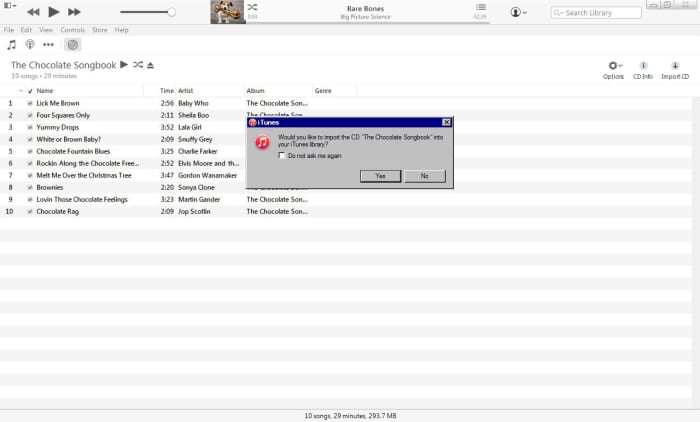
When you lot insert a CD that iTunes hasn't encountered before, it retrieves metadata from the Net about the CD title, track names etc.Information technology likewise prompts you to import the CD onto your estimator.
© Eugene Brennan
Pace 3. Before Importing, Choose Import Settings
ITunes will utilize default import settings for tracks that it rips from CDs and stores equally files in MP3 or other format on your computer. If yous desire to change these settings, click "Abolish" when prompted to import and and so click "Import CD" on the toolbar which brings upwards the import options dialog. If you don't run across this button, click on the icon on the toolbar which looks like a CD, to bring you to the screen which displays a listing of the tracks on the disk.
File Formats:
Scroll to Continue
Tracks extracted from a CD can be encoded and stored on disk using several formats, but MP3 and AAC are the virtually useful. AAC files are the successor to MP3 and offer improve sound quality at the same chip charge per unit, but MP3 is more universally playable on a range of music devices. Both are lossy formats which means that raw uncompressed digital sound data from a CD is compressed using algorithms to make it smaller and accept up less file space. In the process, data is thrown away. By choosing different bit rates and sample rates, you become a tradeoff between file size and audio quality.
On the "Import Settings" dialog that appears, cull the file format from the "Import Using" drop downwards menu, so option "Custom" from the "Setting" drop down menu.
Alternatively Select "Edit" -> "Preferences" from the iTunes card and and so click the "Import Settings" button on the dialog.
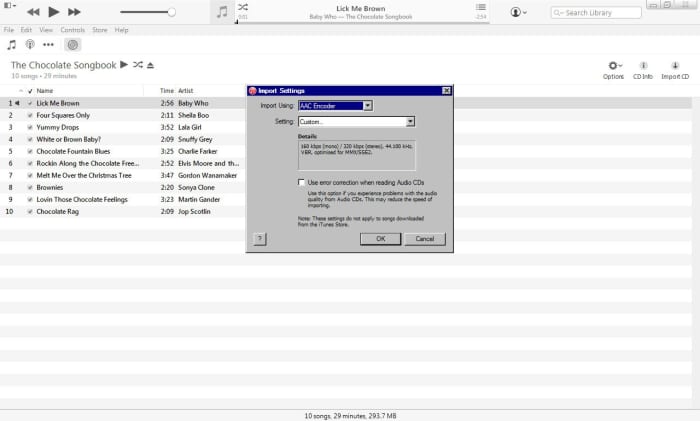
When you click on "Import CD", this dialog appears.
© Eugene Brennan
One time you select custom, a second dialog box appears where you tin set the sample and bitrates.
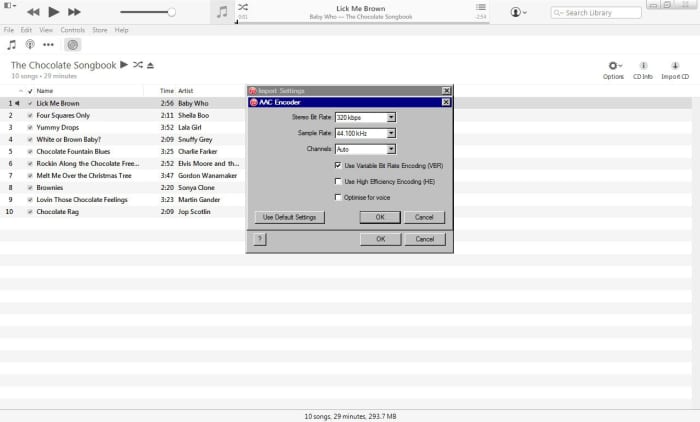
When you option "custom" from the drop down menu, a 2d dialog appears.
© Eugene Brennan
Pick the bitrate from the drop downward menu. 320 kbps (kilo bits per second) at 44.1 kHz is CD quality sound, typically resulting in 4 to 12 MB per runway. The downside of highest quality is larger files that take upwards more than infinite on your computer or mobile device.
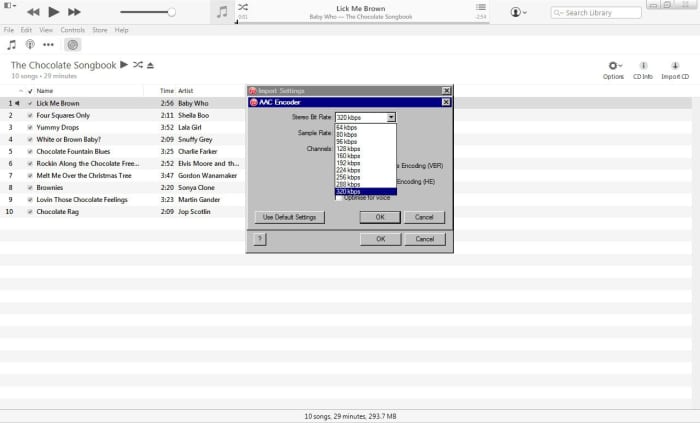
Choice the sample and bitrates. 320 kbps gives CD quality sound, just produces the largest files on disk.
© Eugene Brennan
Footstep iv. Importing CD Tracks
Once you've finished irresolute storage settings, iTunes will commence the import and encoding process, creating files on deejay.
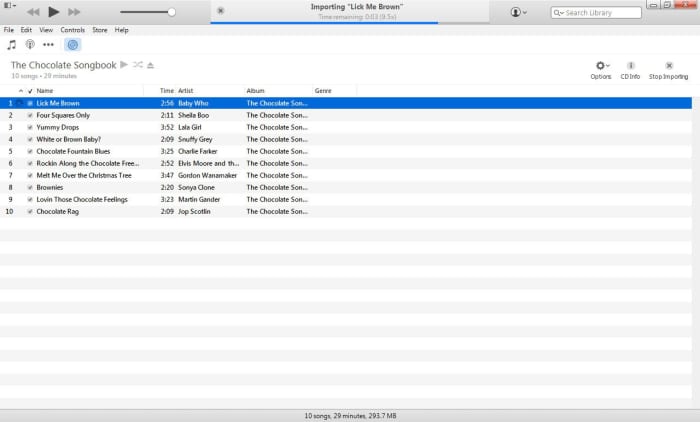
One time you've exited the setting dialog, iTunes starts importing and saving files.
© Eugene Brennan
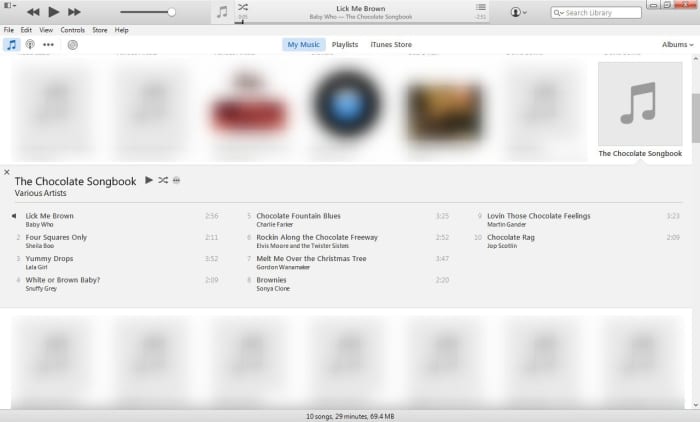
The imported CD appears in "My Music" or "Library", depending on iTunes version. This is how it looks on an older version of iTunes.....
© Eugene Brennan
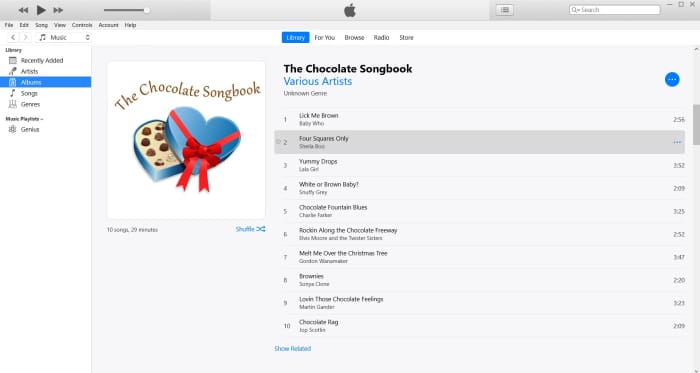
....and this is how it appears on the latest version of iTunes for Windows 10.
© Eugene Brennan

© Eugene Brennan
How to Upload Music to the Cloud
Steps to uploading MP3 or AAC files to YouTube Music.
To find where your music tracks have ended up on your computer, select "Edit" then "Preferences" from the iTunes menu. This brings up the settings dialog. Click on the "Advanced" button on the dialog toolbar. The media storage location is shown at the superlative of the dialog. By default, the storage location is driveletter:\Users\userprofilename\Music\iTunes\iTunes Media. And then if the drive letter is "C" and your Windows user contour proper noun is joebloggs, the binder location would exist
c:\Users\joebloggs\Music\iTunes\iTunes Media
Another way of finding your media folder is by using the Windows File Explorer organisation utility. In Windows 10, the iTunes media binder is located nether "This PC" > "Music" > "iTunes" and called "ITunesMedia".
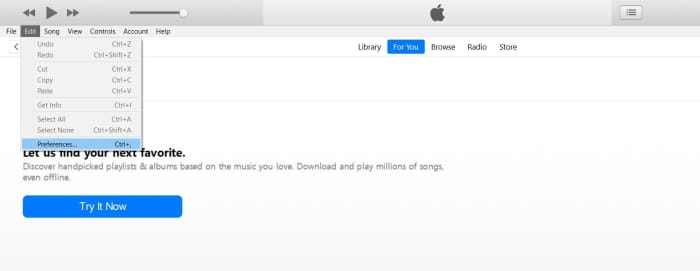
To find where music tracks are stored on your computer, first click "Edit" on the master menu and and so "Preferences"....
© Eugene Brennan
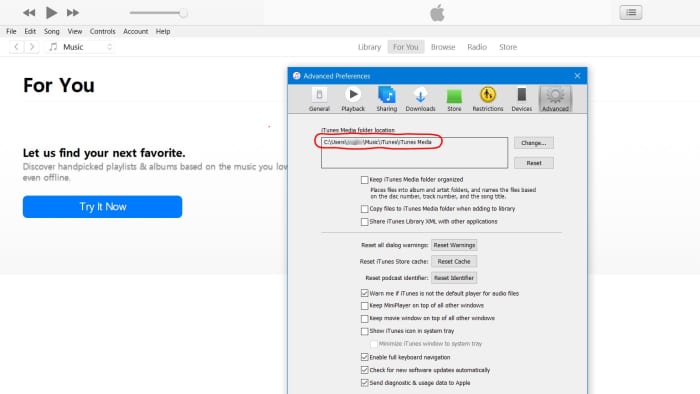
Then click the "Advanced" button on the toolbar. The media binder location is shown at the top of the dialog.
© Eugene Brennan
Step 2. Browse to the Youtube Music Website
Using your browser, navigate to the Youtube Music website at music.youtube.com.
Annals on the website if you haven't done and then already.
Step 3. Start Uploading Files
Click on your profile avatar in the top right corner of the screen and select "Upload Music" on the dialog box that appears.
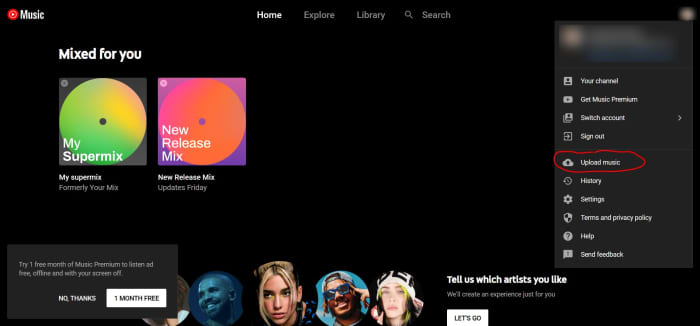
Click on your profile avatar at the acme right of screen and then click "Upload files".
© Eugene Brennan
Step 4. Select Files for Upload
In one case you select "Upload Music", iTunes will open up a dialog window asking you which files you want to upload. In this file upload dialog, navigate to the iTunes media folder that you identified earlier in this guide and find the sub binder corresponding to the album you extracted from the CD. Open the binder past clicking on its name. Highlight all the files yous want to upload (simply draw a rectangle around them with your mouse) and click the "Open up" push button.
How do I know the proper noun of the folder corresponding to my album?
ITunes creates a new folder for each CD it rips tracks from. Get-go information technology creates a new sub folder under the "iTunes Media" folder (iTunes Music on older versions of iTunes) named after the album artist. Side by side information technology creates a sub binder off that folder, named after the CD title. If additional CDs by the same album artist are ripped, further sub folders are created off the artist's folder. Compilation albums are stored somewhat differently. Because the metadata of my "The Chocolate Songbook" album specifies information technology as a compilation, it'due south stored in a special "Compilation" folder for these type of CDs, and a subfolder called "The Chocolate Songbook" stored in this.
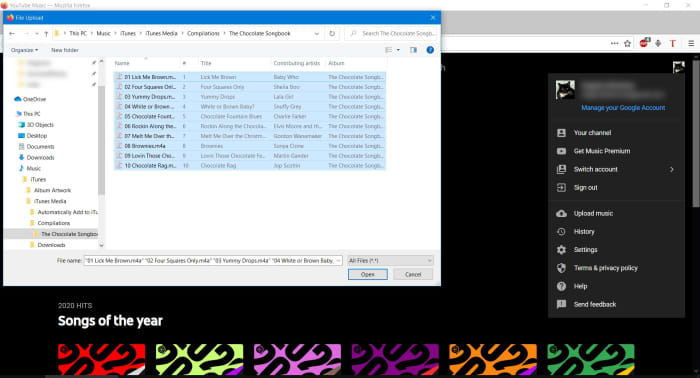
Navigate to the iTunes media binder and highlight files.
© Eugene Brennan
Footstep 5. Wait for Files to Upload.
Depending on your Internet connection speed, information technology can have from seconds to a minute for files to upload. Once upload is complete, you can view the anthology by selecting "Library" on the bill of fare and so "uploads" from the drop downward bill of fare.
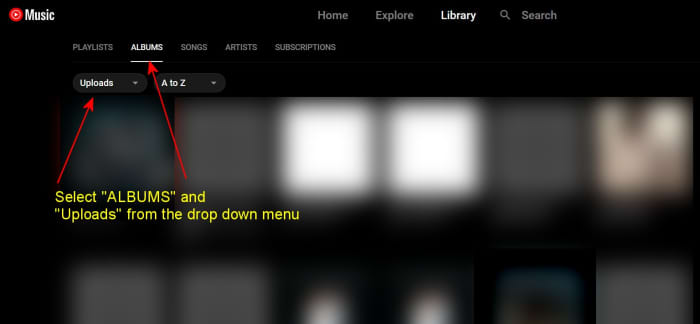
Navigate to the albums screen.
© Eugene Brennan
Your album appears in a grid of albums you may have uploaded previously. Click on the album to view and play the tracks.
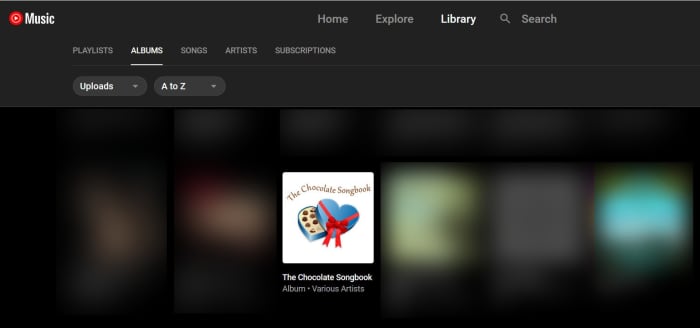
Your album is displayed along with other uploaded albums.
© Eugene Brennan
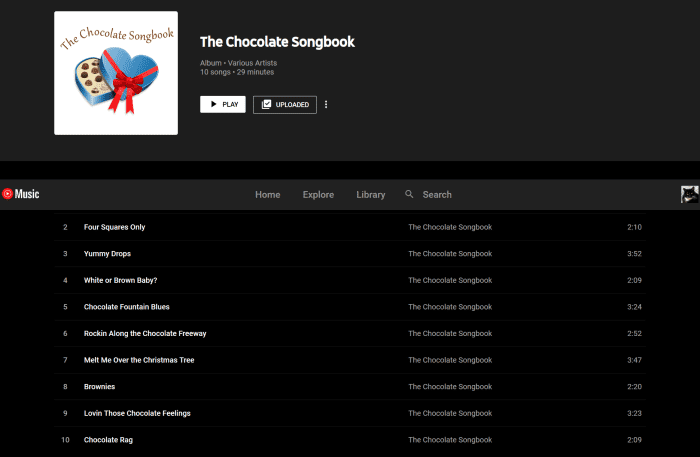
Click on the album artwork to view and play tracks.
© Eugene Brennan
What If I Don't Have a CD Drive in My Computer?
Most laptops no longer come equipped with a CD/DVD bulldoze. They've pretty much get obsolete like a lot of calculator hardware as new engineering has become available. Software applications used to be provided on a CD because the files were besides large to download over the Net. Now that's not an issue equally connexion speeds have increased dramatically since the days of dial-upwards Internet. Also many people now stream music and movies online, so sound CDs and DVDs are no longer the merely selection for listening and viewing. You can purchase a CD/DVD read/write drive that plugs into a USB port similar this one from LG Electronics, available on Amazon. It has a 24x CD write speed and 8x speed for writing DVDRs. The drive has a USB two.0 interface which is likewise uniform with USB 3.0 ports (sometimes marked with "SS" or a blue connector piece).
References:
HowStuffWorks: How MP3 Files Piece of work
SoundBridge: Audio Formats and File Types
Diffen: AAC vs MP3
How-to Geek: Do Music CDs Contain the Necessary Metadata for the Tracks on Them?
RIAA: Nearly Piracy
The Guardian: High court quashes regulations allowing people to copy CDs
Wikipedia: Private Copying Levy
This commodity is accurate and true to the best of the author's knowledge. Content is for informational or amusement purposes only and does not substitute for personal counsel or professional person advice in business, financial, legal, or technical matters.
© 2022 Eugene Brennan
aldridgewholing94.blogspot.com
Source: https://turbofuture.com/home-theater-audio/How-to-Upload-CDs-to-the-Cloud-and-Put-Your-Music-Collection-Online
0 Response to "I Want to Upload All My Cds to My Phone How Do I Do That"
Post a Comment